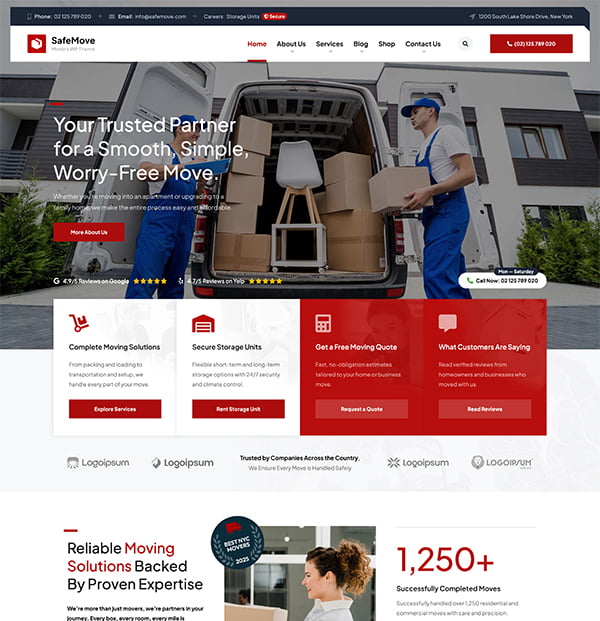

Running a moving company is hard enough, your website shouldn’t make it harder. But if you’re staring at a blank page or wondering why your site isn’t bringing in leads, the question is simple: what should actually be on my website?
Many moving company sites either try to do too much, cluttering visitors with endless pages, or too little, leaving just a homepage and a phone number. The result? Potential customers leave without ever calling.
This guide will show you exactly what pages your site needs, what content works, and what mistakes to avoid. Whether you’re building from scratch or giving your site a complete overhaul, these tips will help you turn visitors into paying customers, without the guesswork.

1. Homepage: Your First (and Most Important) Impression
Your homepage has one job: convince someone to take the next step, whether that’s calling you, filling out a quote form, or clicking through to learn more.
Most people visiting your moving company website are already in the middle of planning a move. They’re stressed, they’re comparing options, and they’ll make a decision within seconds of landing on your page. That means your homepage needs to be clear, fast, and focused.
What to include on your homepage:
- A headline that says what you do and where: be specific
- Your phone number, large and visible without scrolling
- A quote request button or short contact form above the fold
- A brief overview of your main services
- Trust signals: years in business, number of moves completed, star rating
- A few short customer reviews or testimonials
A few Headline examples:
❌ Weak: Welcome to Amsterdam Movers — We Move You
✅ Strong: Stress-Free Moving in Amsterdam — Get a Free Quote in 2 Minutes
❌ Weak: Professional Moving Services
✅ Strong: Local & Long-Distance Moves in New York — Trusted by 500+ Families
Don’t try to explain everything on your homepage. Its job is to get people to take the next step, the details live on your other pages.
2. Services Page: Tell People Exactly What You Do
A lot of moving companies skip this page or bury it inside the homepage. That’s a mistake, both for your visitors and for Google.
A dedicated services page tells visitors exactly what you offer, sets expectations upfront, and helps you rank for service-specific searches like “piano moving New York” or “office relocation London.”
Common moving services to list:
- Local moves (same city or region)
- Long-distance or national moves
- Packing and unpacking
- Furniture assembly and disassembly
- Storage solutions (short and long-term)
- Office and business relocations
- Specialty moves: pianos, artwork, antiques
If you offer several distinct services, consider giving each one its own dedicated page rather than listing them all on one. It takes more effort upfront but pays off a dedicated “Office Moving Amsterdam” page will outrank a generic services page almost every time.
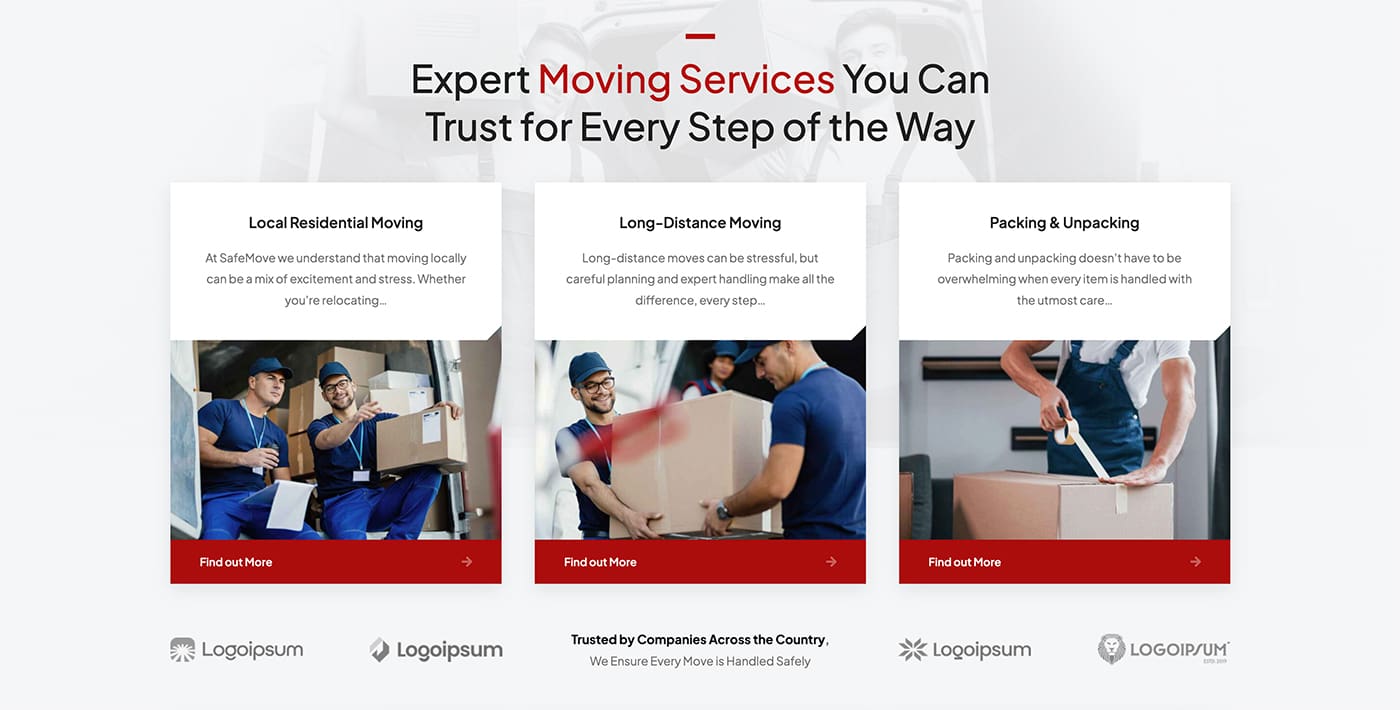
Above is a preview of a service page from our SafeMove theme. If you want to see how it works in practice, the theme includes ready-made templates for individual service pages.
Be honest about what you don’t do too. If you don’t move internationally, say so. It filters out the wrong enquiries and builds trust with the right ones.
3. About Page: Stop Being a Stranger
Moving is stressful. People are handing over everything they own to a team they’ve never met. Your about page is where you stop being a faceless company and become a real person they can trust.
This is one of the most underrated pages on a moving company website. Done well, it’s a powerful trust-builder. Done poorly (or skipped entirely), it leaves potential customers with one more reason to choose a competitor.
What to include:
- Your story: how and why you started the company
- Who’s actually doing the moving: names and faces matter
- Your values and what sets you apart from other movers
- Your service area and how long you’ve been operating there
- Insurance, certifications, or professional memberships
Tone examples (weak vs strong):
❌ Weak: We are a professional moving company committed to providing excellent relocation services with a focus on customer satisfaction.
✅ Strong: I started this company in 2012 because I was tired of hearing horror stories about movers who didn’t show up, broke things, and then argued about it. There had to be a better way.
Add a real photo of yourself or your team. Stock photos of generic movers carrying boxes do more harm than good, they make you look like every other company. A real photo of your actual crew builds instant credibility.
4. Reviews / Testimonials Page: Let Happy Customers Sell For You
Word of mouth is how most moving companies grow. Your website should work the same way.
A dedicated reviews page, or at minimum a strong reviews section on your homepage, gives hesitant visitors the social proof they need to pick up the phone. People trust other customers far more than they trust your marketing copy.
What makes a review convincing:
- Specific details: “they moved our upright piano without a single scratch” beats “great service!”
- Real names and locations: “Sarah from London” feels more credible than an anonymous review
- Variety: a mix of local moves, long-distance, office moves shows your range
- Recent reviews: a page full of reviews from 2019 raises eyebrows
After every successful move, ask for a review while it’s fresh. A simple text message two days after the move with a direct link to your Google review page converts much better than a follow-up email two week later.
5. Quote / Contact Page: Make It Dead Simple to Reach You
This is the most important page on your entire website. Every other page exists to funnel people here.
And yet it’s one of the most commonly botched pages on moving company websites. Too many fields, unclear response times, no phone number visible, small friction points that cost you real enquiries.
What to include:
- A short quote request form: name, move date, from/to location, phone number
- Your phone number, large and tap-to-call on mobile
- Expected response time (“We’ll get back to you within 2 hours on business days”)
- Your email address as an alternative contact option
- Your service area, so you don’t get enquiries outside your zone
Form length (weak vs strong):
❌ Weak: A 12-field form asking for exact inventory, floor number, elevator access, parking situation, and preferred move time before you’ve even spoken to them.
✅ Strong: A 5-field form: name, move date, moving from (city), moving to (city), phone number. Collect the rest over the phone.
6. Service Area Page: Your Secret SEO Weapon
This is the most underrated page on a moving company website, and one of the highest-impact ones for local SEO.
When someone searches “moving company Los Angeles” or “movers in Amsterdam,” Google wants to see clear signals that you actually serve those areas. A well-structured service area page, or individual pages for each city, helps you show up in those local searches.
Optional Pages Worth Considering
Once your core pages are solid, these additions can help convert more visitors and improve your search rankings:
FAQ Page
Answer the questions you get asked every week. “Do you provide boxes?” “Are you insured?” “How far in advance should I book?” “What happens if something gets damaged?” A good FAQ page saves you time on the phone and reassures customers before they even contact you. It also ranks well for question-based searches.
Blog
Moving tips, packing guides, neighbourhood guides for your service area, what to do first when you move to a new city. A blog builds your authority in local search over time and brings in visitors who are in the early stages of planning a move before they’ve picked a mover. That’s your chance to be the helpful expert they remember when they’re ready to book.
Photo Gallery
Before/after photos of moves, your truck fleet, your team in action. Real photos from real jobs build far more trust than stock images. Even a handful of genuine photos will set you apart from competitors who rely on generic imagery.
Pricing Page
This one’s optional because pricing for moves varies so much. But if you offer fixed-rate local moves or transparent pricing structures, publishing them can actually be a competitive advantage. It filters out price-sensitive leads and builds trust with customers who hate surprises on moving day.
A Note on SEO for Moving Company Websites
Getting your pages right is the foundation of a moving company website that actually gets found on Google. Here’s a quick SEO checklist to apply to every page you create:
- Include your city name naturally in the page title, first paragraph, and at least one heading
- Write a unique meta description for every page (the short text that shows up in Google results)
- Add alt text to every image, describe what’s in the photo and include your location where relevant
- Make sure your phone number is in text, not an image, Google can’t read images
- Get your business listed on Google Business Profile if you haven’t already, it’s free and essential for local search
- Ask happy customers to leave Google reviews, they directly affect your local ranking
None of this is complicated. The moving companies that rank well locally aren’t doing anything magical they just have clear, well-structured pages that say exactly what they do and where they do it.
Now Go Build It
You really don’t need a complicated website. Just make it clear and easy to understand. If you get these six pages right, you’ll already have something that can bring in real business. You can always add more later when you feel ready.
Your Moving Company Website, Ready in a Weekend
Every page from this guide, already built. Just add your content and go live.